The Open Question
The healthy brain continuously matches its blood supply to the activity of its neurons—a process known as neurovascular coupling. This rapid response relies on electrical signals travelling through capillary endothelial cells to upstream blood vessels. Previous studies identified Kir2.1 potassium channels as essential for this communication, but it remained unclear how these channels are maintained in a functional state and how endothelial cells sustain this signalling over time.
The Approach
We combined genetically modified mouse models with electrophysiology, high-resolution imaging, pharmacological experiments and cerebral blood flow measurements to investigate how Arf6 regulates endothelial electrical signalling and neurovascular coupling.
What the data showed
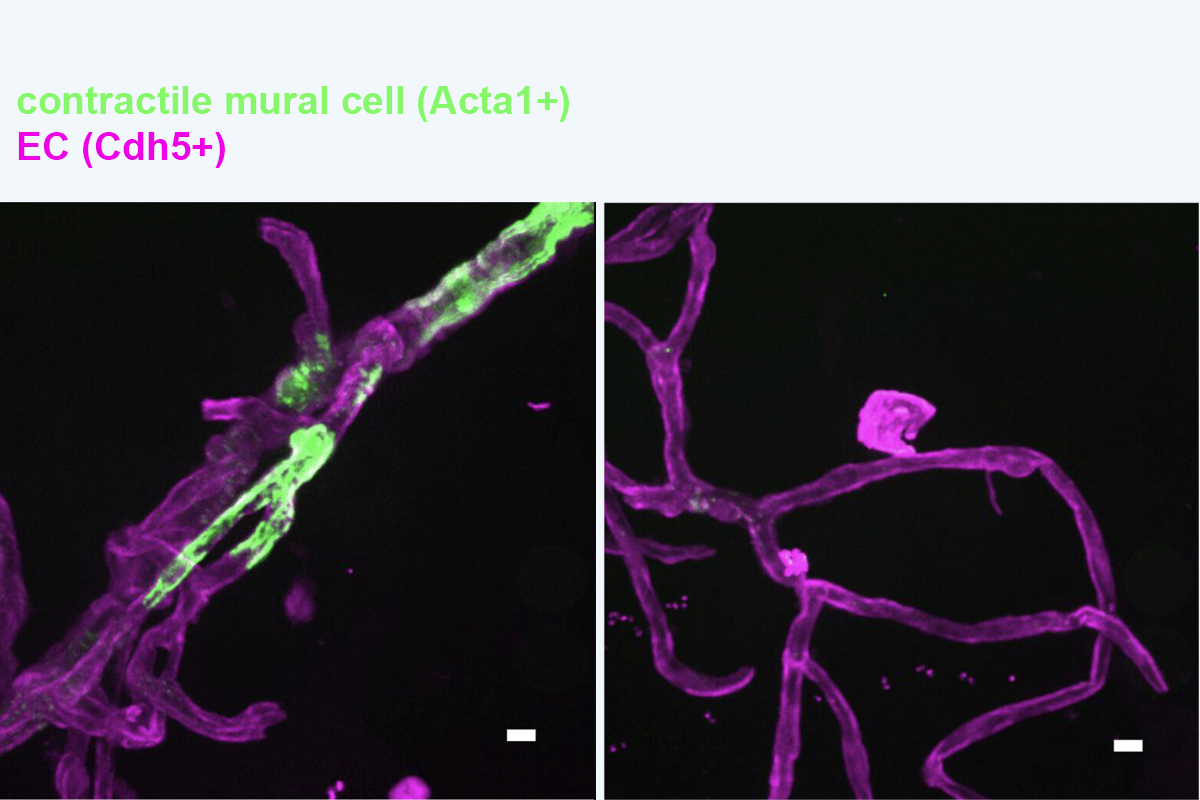
We found that Arf6 maintains the membrane lipid PIP₂, which is required for Kir2.1 channel activity in endothelial cells. Loss of Arf6 disrupted electrical communication along capillaries, weakened neurovascular coupling and reduced blood flow responses to neuronal activity. Restoring PIP₂ rescued endothelial signalling and cerebral blood flow.
What this changes
The study identifies Arf6 as a critical regulator of neurovascular coupling and reveals a previously unrecognised mechanism that helps maintain adequate cerebral blood flow. These findings may provide new opportunities to understand and eventually treat disorders associated with impaired brain perfusion.
Relevance for CRC1744
Understanding how endothelial cells coordinate cerebral blood flow is central to CRC1744. By uncovering a mechanism that links endothelial signalling to neurovascular function, this work advances research into vascular dysfunction, disease progression and cerebrovascular disorders.
This study was led by Prof. Mark T. Nelson (University of Vermont), with CRC 1744 member Prof. Martin Dichgans (Projects A02 and A07), Institute for Stroke and Dementia Research, LMU Munich)